
EPIK Final Documents Downloads
Complete EPIK document checklist — click any item for description, sample images, and download links.
9
Common (Required)
32
Additional (Situational)
By document
Check Apostille Instructions
Free
Korvia Support
When you apply through Korvia, your recruiter guides you through every document step-by-step. Click each item below to see the description, download links, and sample images. Not every applicant submits every document — your recruiter confirms which ones apply to your profile.
Items marked green are common to every EPIK applicant (9 items). Everything else is additional, submitted only when it applies to your situation — region (SMOE, Incheon), nationality (UK/AU/SA/Quebec), teaching history, or pay-level upgrade paths.
Copies, signatures, and originals
Copies are accepted for documents 2, 3, 4-A, 4-E, 9, 9-B, 14, 14-A, and 20. Submit these only when your coordinator requests them.
The personal essay (2) and lesson plan (3) do not need signatures. The application form (1) still needs your handwritten signature. For a doctor's note (20), copy the note after the doctor has signed it in ink.
For your passport (4), copy the top and bottom pages only, in colour and at actual size. For citizenship proof (4-B), send the document with the original apostille attached.
If you have not graduated, document 6-A is an original university registrar letter stating your expected graduation date. You must still send your apostilled degree (6) by the deadline your coordinator gives you.
Open each document below for its full instructions. A copy means a photocopy or printout for your final document package.
EPIK Final Documents Checklist
Filter by Common · Additional · All. Open any row for instructions, downloads, and sample images.
Required for every EPIK applicant (per the EPIK Official Guideline).
Print your finalised EPIK application, sign it by hand in the signature box, clip your photo to it and send the signed original.
Wait until EPIK has confirmed your final version. If EPIK asks for changes at your interview, a form you already signed and posted has to be printed, signed and sent again.
Before printing, make sure every revision you were asked to make is in the form. You cannot edit it yourself, so tell your Korvia coordinator what to change.
Print every page, including the personal essay and the lesson plan. If you have lesson plan materials such as handouts, worksheets or slides, print those too.
Sign it by hand in the signature box. A digital or typed e-signature is not accepted — EPIK only takes an ink signature on the printout.
Open and print the PDF in the latest free Adobe Reader, install the extra fonts if asked, and set the print option to "Fit". Other PDF viewers often print it incorrectly.
Check the printout: check boxes, circled numbers and symbols must print correctly, and no page may be cut off.
Print single-sided on your country's paper size. Black and white is fine.
Attach your passport photo (document 1-A) to the form with a paper clip.
The date printed on the form stays as your first submission date, so you do not need to update your age.
Send the signed original.
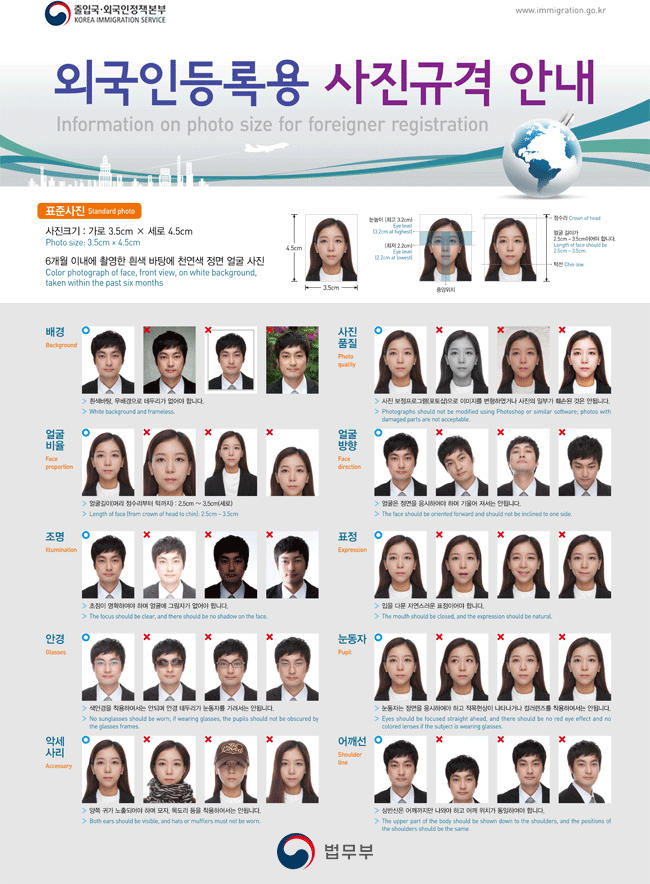
One developed colour passport photo (3.5 x 4.5 cm) from a photo shop, taken in the last 6 months, clipped to your application.
It must have been taken within the past 6 months.
Passport style: shoulders up, facing forward, on a plain single-colour background. Smiling is fine.
Your head, neck and whole face must be visible. Glasses for sight correction are fine; no hats, scarves or other accessories unless you wear them daily or frequently for religious reasons.
Standard passport size (3.5 x 4.5 cm), in colour.
It must be a developed photograph from a photo shop or photo printing service. A photo printed on a home or office printer is not accepted.
EPIK needs one photo only — attach it to your application form (document 1) with a paper clip. (Other programmes ask for two: one for the application and one for your visa application at immigration.)

Print and submit a copy of the personal essay included in your EPIK application; no signature is required.
It is already included in your EPIK application form. Print it together with the application (document 1).
Print it even if the text looks small.
A photocopy or printout is accepted. You do not need to sign this document.
The application form itself (document 1) still requires your handwritten signature.
Print and submit a copy of the lesson plan included in your EPIK application; no signature is required.
It is already included in your EPIK application form. Print it together with the application (document 1).
Print it even if the text looks small.
If you have lesson plan materials such as handouts, worksheets or slides, print those too.
A photocopy or printout is accepted. You do not need to sign this document.
The application form itself (document 1) still requires your handwritten signature.
Copy the top and bottom passport pages only, in colour and at actual size.
Copy the top and bottom pages in full, in colour. Keep all text and page edges visible.
Copy it at actual size. Do not enlarge or reduce it.
Your passport must be valid for at least 18 months from your expected contract start date.
Your name on every other document must match the legal first name and surname in this passport, including accents, hyphens and suffixes.
If you hold dual citizenship, send the passport you will use to enter and work in Korea.
If you hold Korean citizenship (dual or otherwise), you must enter Korea on your Korean passport to work legally. Confirm your citizenship status early.
A national-level criminal record check from your country of citizenship, with a physical apostille attached.
Start this first.
It must come from the national police authority of your country of primary citizenship. Checks from state, provincial or local police are not accepted.
EPIK (E-2-2): the check must be issued on or after 1 August for a spring intake, or on or after 1 January for a fall intake. EPIK sets it this way because your visa is applied for about a month before you arrive — it is not six months counted from your contract start date.
Applying for a different E-2 visa (a single school, not EPIK)? There the check must be issued within 6 months of the day you apply for the visa, regardless of your contract start date.
A physical national-level apostille must be attached to the original check. Digital apostilles are not accepted.
US: an FBI background check, apostilled by the US Department of State Office of Authentications in Washington, D.C. A state-level apostille on a notarized copy is not accepted.
Canada: the original RCMP fingerprint check, apostilled by Global Affairs Canada. A provincial apostille on a notarized copy is not accepted.
UK: DBS Basic Disclosure (England & Wales), Disclosure Scotland Level 1, AccessNI Basic Disclosure or ACRO, apostilled by the Legalisation Office.
Australia: Australian Federal Police + Department of Foreign Affairs and Trade. Ireland: An Garda Síochána + Department of Foreign Affairs.
New Zealand: Ministry of Justice + Department of Internal Affairs. South Africa: South African Police Service + Department of International Relations & Cooperation.
UK and Australian applicants who have changed their legal name: list all former legal names on the application so they appear on the result.
Do not remove or detach the apostille. A detached or damaged document is invalid and you will have to get a new one.
A notarized copy of your bachelor's degree with a physical apostille attached.
Send the apostilled document itself.
It is required even if you have a higher degree. A master's or other qualification cannot replace it.
Have a notarized/authenticated copy apostilled rather than your original degree. EPIK cannot guarantee that documents are returned.
An official digital degree is fine if it can be notarized and apostilled as a physical copy.
The apostille must be physical and in English (or come with an official English translation). E-apostilles are not accepted.
US: a notary public (or your university) notarizes a copy, then the same state apostilles it. It does not have to be the state where your school is located.
Canada: the notarized copy can be apostilled at the provincial level.
South Africa: apostille the original SAQA Verification Letter together with a notarized/verified copy of your standard (non-honours) bachelor's diploma.
Degree not issued in English? Also send an official English translation from your university. The translation does not need to be notarized or apostilled.
Were you issued only a master's certificate through a combined or extended programme? Send supplementary paperwork explaining why, showing it includes a bachelor's-level qualification.
Do not remove or detach the apostille. A detached or damaged document is invalid.
Two sealed official transcript sets for your bachelor's degree — Korvia checks one, EPIK checks the other.
Send two sealed sets. Korvia opens one to check it for you; the second one stays sealed and goes to EPIK, who check it themselves.
Keep the envelope sealed. It needs a marking on or over the seal that proves it has never been opened.
The transcript must clearly state when your degree was completed or conferred.
It should show all coursework, credits and grades that counted towards the degree.
Attended the degree-issuing university for less than 2 years? Also send sealed transcripts from your previous schools (document 7-A). Study-abroad transcripts are not needed.
Not graduated yet? Send sealed in-progress transcripts now, then sealed final transcripts after your degree is conferred, by the deadline your Korvia coordinator gives you. If they do not arrive in time, you lose your position.
If your university cannot issue physical transcripts, tell your Korvia coordinator so they can advise another way to submit them.
Two original, ink-signed letters on letterhead from a supervisor, professor or similar, with a typed full date and your legal name.
The referee must be a supervisor, manager, professor, academic advisor, co-teacher or other professional source. Friends, family members and co-workers are not accepted.
If you are teaching in Korea now, at least one letter must come from your current school (e.g. a co-teacher or the principal/director).
Not accepted: letters from freelance work, independent nannying, babysitting, au pair work or tutoring, or from online TEFL/TESOL course providers.
Letters from volunteer groups or social clubs count only in a teaching or education context. Letters from religious organisations count only for teaching/education experience or professional employment.
Typed and printed on official letterhead (with logo, address and contact details), or sent with the referee's official business card paper-clipped to it. Images do not count, and handwritten letters are not accepted.
Letters from Korean schools must state the school's name, address and phone number, and be signed by the referee or carry their personal seal.
Include the referee's name, title/position and contact details, ideally both a phone number and an email address.
Signed by the referee in real ink. Traced or doubled signatures (for example an ink signature next to a printed one) are not accepted.
A typed, full date of issue within 2 years of the opening date of the application period. Ask your Korvia coordinator for the earliest date for your intake.
Your full legal first and last name as in your passport. A nickname can be used after that.
In English or Korean only. Korean letters must show your full name in English letters at least once. Translations of other languages are not accepted.
1-2 pages, with a real character reference about your (potential) ability as a teacher, not only a description of your role.
Addressed to "To Whom It May Concern" or the "EPIK Team", not to a recruiter, Office of Education or other institution.
State how the referee knows you and for how long, with specific dates.
We check both letters for any sign of a forged signature.
Green = Required for every applicant·Blue = Situational (based on your profile)
Source: EPIK document guidance and Korvia submission instructions. 41 checklist items. Copy and signature guidance updated 17 October 2026.
Important When Applying on epik.go.kr
When completing the EPIK online application, please select “Classification” as Agency — Korvia Consulting. Our team cannot access or review your application if you fail to select the correct classification.
Downloads FAQ
Q.Do I need every document on this list?
No. This checklist includes common and situational documents. Your Korvia coordinator confirms which items apply to you. Open each requested item for its copy, original, and signature requirements.
Q.What documents require apostille?
Check each document requested by your Korvia coordinator. Documents 5 (criminal record check) and 6 (degree) have apostille instructions. If document 4-B (proof of citizenship) is requested, send the citizenship certification with the original apostille attached. A photocopy of that apostilled document is not accepted.
Q.How recent must my Criminal Record Check be?
Your CRC must be issued within 6 months of your EPIK start date. If you obtain it too early, it will expire before placement. Timing is critical — your Korvia recruiter coordinates the CRC request window to match your intake timeline.
Q.I don't have a TEFL certificate yet. Can I still apply?
Yes, but you will be classified as Level 3 (not currently hired in most provinces). A 100+ hour TEFL/TESOL/CELTA certificate is effectively required for EPIK — it's both an eligibility factor and a salary tier determinant. Online TEFL courses are accepted. Plan 4-8 weeks to complete a reputable TEFL program.
Q.Can I submit documents as PDFs, or do I need hard copies?
A copy is accepted for documents 2, 3, 4-A, 4-E, 9, 9-B, 14, 14-A, and 20. This means a photocopy or printout for your final document package; it does not mean a PDF alone completes submission. Documents 2 and 3 do not need signatures. Document 1 still needs your handwritten signature, and document 4-B needs the original apostille attached. Follow your Korvia coordinator's instructions for sending the package.
Q.What if my document is rejected?
Common rejection causes: missing apostille, wrong apostille authority, outdated CRC, unsealed transcripts, or incorrect TEFL verification. Your Korvia recruiter reviews each document before submission to minimize rejections. If a document is rejected by the province, we help you correct and re-submit — though this may delay your start date by 4-8 weeks.
Need Help With Your EPIK Documents?
Apply through Korvia and your recruiter will guide you step-by-step.