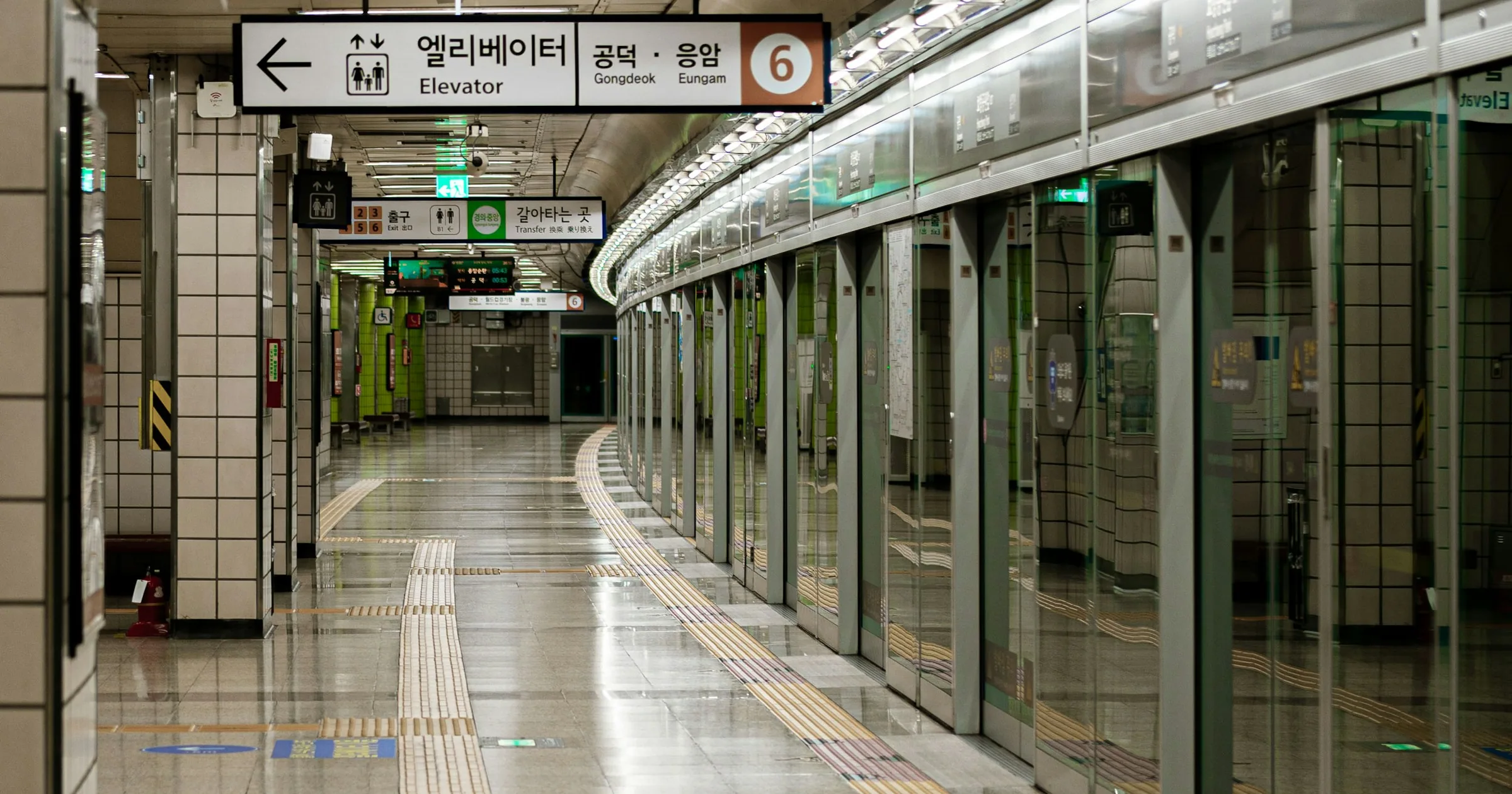
Korea's public transportation system is one of the most reliable, efficient, and affordable in the world. Whether you're an English teacher arriving for your first contract, an expat relocating for work, or a job applicant exploring your options, mastering transit in Korea unlocks independence and saves you thousands of won per month compared to taxis and ride-hailing alone.
This guide walks you through every major transit method in Korea — from the Seoul subway to KTX high-speed trains, from Kakao T taxis to AREX airport trains. We'll cover practical payments (T-money, Apple Pay), navigation apps (Naver Map vs Kakao Map), foreigner-specific passes, accessibility, and real cost breakdowns so you can budget and plan with confidence.
The 5-Minute Starter Pack: Three Things You Need Today
If you're arriving in Korea this week, here's the absolute minimum:
- T-money card. Buy one at any convenience store (GS25, CU, 7-Eleven, or Emart24). Cost: ₩2,500–₩4,000 card fee, plus your first charge (usually ₩10,000–₩20,000). This single card works on subways, buses, taxis, and even convenience store payments nationwide.
- Naver Map app.Download it before your flight. It's the gold standard for public transit routing in Korea with real-time subway and bus schedules, English support, and integration with Naver payments.
- Kakao T app.This is Korea's primary ride-hailing app for taxis. Download it, register your phone number (you can use a temporary Korean prepaid SIM), and you can book rides from day one.
That's your foundation. Everything else in this guide is optimization.
T-Money Card: Comprehensive Guide to Korea's Universal Transit Pass
Where to buy and how to set up
T-money cards are ubiquitous. Walk into any convenience store and ask for "T-money" (the staff will understand). You'll pay a one-time card fee (₩2,500–₩4,000 depending on the card design) and then add your first balance in cash or, as of March 2026, with a foreign credit card at supported kiosks.
Once activated, your T-money card becomes your gateway to the entire transit ecosystem: subways, city buses, express buses, airport limousine buses, many taxis, and hundreds of convenience stores nationwide.
Topping up your card: Cash, foreign cards (March 2026 update), and apps
For years, topping up T-money required either cash at kiosks or a Korean bank account. As of March 2026, this changed significantly.
| Method | Availability | Minimum Charge |
|---|---|---|
| Cash at subway kiosks | Nationwide (ubiquitous) | Any amount (typically ₩10,000+) |
| Foreign credit card (Visa/MC/Amex) | Major cities (Seoul, Busan, Daegu, etc.) | ₩10,000–₩100,000 |
| Convenience store checkout | Most convenient stores nationwide | ₩1,000–₩100,000 |
| T-money mobile app | iOS/Android (requires Korean bank or card) | Any amount |
| Kakao Pay / Naver Pay | Most kiosks and convenience stores | ₩1,000–₩100,000 |
Korvia Tip
The foreign credit card kiosk acceptance varies by station and city, but it's rapidly expanding. Always test your card at your local subway station's kiosk in your first week. If it fails, keep cash on hand or ask your co-teacher where the nearest convenience store with accepted payment is.
T-money pricing and transfer discounts
Single rides cost around ₩1,400–₩1,500 for subways and buses depending on distance. The real magic is the 30-minute transfer discount: if you tap your T-money card again on a different bus or subway within 30 minutes of your first tap, the second ride is either free or deeply discounted.
This transfer window works across transit types too, so you can take a subway and connect to a bus (or vice versa) and still qualify for the discount. Plan your route accordingly and you'll rarely pay full fare twice.
Refunding your T-money card
Before you leave Korea, your T-money card balance can be refunded. Visit a convenience store and ask for "T-money 환불" (refund). They will process a refund to cash, though the card fee is usually not returned. Keep your receipt and the card itself to complete the refund.
Seoul Subway: System Overview, English Navigation, and Avoiding Peak Hours
Line structure and major stations
Seoul has 9 main metro lines plus 8 commuter lines, color-coded and numbered for clarity. English signage is comprehensive, with both Romanized station names and English translations on all platforms. Major hub stations (Gangnam, Seoul Station, Jongno 3-ga, Insadong) have English-speaking staff and information booths.
For teachers living outside Seoul, commuter lines (Bundang Line, Shinbundang Line, Incheon Metro) extend service to bedroom communities where much of the affordable housing is located. Your Naver Map app will show exact transfer points and which line to take.
Transfers and connection safety
Seoul's subway is engineered for transfers. Following color-coded signs and the English signage, you can navigate between any two lines in under 5 minutes at well-designed stations. Stations like Jongno 3-ga (serving 5 lines) can be more complex, but even there, the signage is logical.
For security, stations are well-lit and monitored by CCTV. Women's-only cars (typically the first or last car, marked with a pink line) are common and safe. Avoid traveling alone very late at night (after midnight) in less-busy outer stations, though the system is generally very safe compared to Western cities.
Peak hours and scheduling strategy
Rush hour is 7:30–9:00 am and 5:30–7:30 pm on weekdays. Trains are packed shoulder-to-shoulder during these windows. If your schedule allows, avoid peak hours by arriving at work 30 minutes earlier or leaving 30 minutes later.
Most teachers don't have this luxury, so adjust your expectations: you will experience crowded trains. The silver lining is frequency — trains run every 3–5 minutes during rush hour, so even if one is too packed, another arrives within seconds. Weekends are much calmer, running every 10–15 minutes.
Korvia Tip
If you live close enough to walk or bike to school, you'll save hours per month in commuting. Many EPIK placements intentionally house teachers within walking distance of their schools. Ask your placement coordinator about the commute distance before you arrive.
Navigation Apps: Naver Map vs Kakao Map (English Support and Real-Time Routing)
Naver Map: The transit expert's choice
Naver Map is owned by Naver, Korea's dominant search company, which gives it access to real-time transit data directly from Seoul Metro and bus operators. The English interface is comprehensive and includes detailed arrival times, platform numbers, and exit recommendations.
Search for your destination, select the "Public Transport" tab, and you get a ranked list of routes by travel time with exact fare and transfer points. It integrates with Naver Pay for direct booking on some services, though you'll primarily use it for planning.
Kakao Map: Intuitive and taxi-integrated
Kakao Map is slightly more intuitive for casual users and has a critical advantage: native integration with Kakao T (Korea's primary taxi app). While Naver Map shows transit routes well, Kakao Map allows you to seamlessly switch between "I want to take a bus/subway" and "I want to book a taxi right now" without leaving the app.
English support on Kakao Map is good but slightly less comprehensive than Naver Map. For transit planning, Naver is marginally better; for overall mobility including taxis, Kakao is more convenient.
Practical advice: Use both
Most experienced expats in Korea install both apps. Use Naver Map for detailed transit routing and Kakao Map for taxi integration and quick re-routing if you're running late or conditions change. The slight redundancy is worth the flexibility.
Bus System: City Buses, Express Buses, and Airport Limousine Buses
City buses vs express buses: Speed, comfort, and cost
Seoul and major cities have two categories of buses: regular city buses (stopping every 2–3 blocks, same price as subway, around ₩1,400–₩1,500) and express buses (faster routes with fewer stops, slightly higher fare around ₩2,100–₩2,500).
City buses are your daily workhorses — they cover neighborhoods that the subway doesn't reach. Express buses are useful for longer cross-city trips where saving 15–20 minutes is worth the extra ₩1,000. Your Naver Map or Kakao Map app will show both options with time and cost.
Airport limousine buses
For trips from central Seoul to Incheon or Gimpo airports, limousine buses are the overlooked hero: they cost ₩6,000–₩10,000, run every 15–30 minutes, and include luggage space (unlike the subway or taxis). They're less exciting than the AREX express train, but often more convenient if your hotel or apartment is near a pick-up stop.
Limousine bus stops are marked clearly at hotels, shopping centers, and apartment complexes. You can book online or pay the driver directly.
Taxi Apps: Kakao T, k.ride, Uber, and Traditional Flag-Down (April 2025 Update)
Kakao T: The dominant choice
Kakao T is used for 80%+ of app-booked taxi rides in Korea. Fares are metered and transparent before you book, starting at ₩3,800–₩4,800 for a basic ride, with surge pricing during rush hours and late nights (1.2x–1.5x multiplier common). All drivers are registered taxis, background-checked, and rated.
The app works with just a Korean phone number. You can request a ride in seconds, track the driver in real-time, and pay by card or cash (both are standard). Receipts are automatic, useful for expense reports if needed.
k.ride: New foreigner-friendly alternative (April 2025)
k.ride launched in April 2025 as an alternative ride-hailing platform explicitly designed for international users. English language support is native (not translated), and registration accepts international phone numbers without requiring a Korean bank account or ARC.
While k.ride's driver network is smaller than Kakao T, it's rapidly expanding in Seoul and major cities. For expats arriving without full Korean infrastructure set up yet, k.ride can be a useful bridge until you open a Korean bank account and set up Kakao T payments fully.
Uber: Limited presence
Uber operates in select cities (Incheon, Jeju) but is not available in Seoul or most major Korean cities. Kakao T and local competitors have effectively dominated the market. Don't plan on Uber as a primary option.
Traditional flag-down taxis
You can always hail a taxi on the street by raising your hand. Fares are metered and cheaper than app-booked rides (no platform fee), starting at ₩3,000 for the initial drop. However, communication can be difficult if the driver doesn't speak English. Most drivers have a laminated English phrase sheet, but typing your destination into their GPS or showing them a map on your phone is faster.
Korvia Tip
Taxis are expensive compared to public transit. A subway ride costs ₩1,500, but a taxi for the same distance might cost ₩8,000–₩12,000. Use taxis for emergencies, late-night returns (safer than walking alone), or when carrying heavy luggage. For daily commuting, the T-money subway/bus system is dramatically more economical.
KTX and High-Speed Trains: Booking, Routes, and the KORAIL Pass
What is KTX and why you'll use it
The KTX (Korea Train eXpress) is Korea's high-speed rail network, connecting Seoul to Busan (2h 40m), Daegu (2h), Daejeon (1h 10m), and dozens of other cities. Trains run every 15–30 minutes during the day, with comfortable seats, power outlets, and a small café car. Fares range from ₩25,000 to ₩65,000 depending on distance and seat class (Standard vs Premium).
For English teachers, the KTX unlocks weekend travel without flying. A Friday evening train to Busan gets you there by 9 pm; Sunday evening you're back for work Monday. Many teachers use the KTX monthly for budget travel across the country.
Booking in English via KORAIL
KORAIL's official English website korail.com allows direct booking with your passport number or foreigner ID. You pay with an international credit card, and the site issues a reference number. Pick up physical tickets at any station counter using your reference number and passport, or print mobile tickets directly (preferred — no queue).
Booking opens 30 days in advance. Peak times (Friday evening, Sunday afternoon) sell out fast, so book early if you want a specific time.
The KORAIL Pass: Worth it for frequent travelers
If you plan more than 3–4 KTX trips per month, the KORAIL Pass (₩65,000–₩170,000 for 3–7 days of unlimited travel) can save money. However, for occasional weekend trips, individual tickets are cheaper. Purchase the pass through korail.com and activate it only when you're ready to use it (it has an expiration date).
Incheon Airport Transfers: AREX Express vs All-Stop vs Limousine Bus
AREX Express: Fast but pricey
The AREX (Airport Railroad) express train gets you from Incheon Airport Terminal 1 to Seoul Station in 43 minutes. The fare is ₩9,000 for express (no stops) or ₩4,750 for the all-stop version (44 minutes to Seoul Station). Your T-money card works on both.
AREX is best if you're staying in central Seoul (near Seoul Station) and want speed without negotiating taxis. However, if your final destination is Gangnam or Bundang (south or east Seoul), you'll spend another ₩1,500–₩3,000 and 20+ minutes on the subway after reaching Seoul Station.
AREX all-stop train: Cheaper and more flexible
The all-stop version stops at intermediate stations (Gimpo, Hongdae, Yeongdeungpo, Incheon Station). If your destination is one of these stops, you save significantly. At ₩4,750, it's cheaper than any taxi and gives you flexibility for layovers or shopping before heading onward.
Limousine bus: Luggage-friendly alternative
A dedicated limousine bus (₩6,000–₩10,000) takes you directly to most major hotels, business districts, and subway stations. If you have a lot of luggage or your destination is off the subway grid, the limousine bus is less stressful than coordinating two transit changes.
Practical advice: Avoid taxis from the airport
Airport taxis are metered, but the starting fare from Incheon is around ₩11,000–₩13,000, plus an additional ₩20,000+ to reach central Seoul (total ₩31,000–₩35,000). This is 3–4x the AREX express cost. Save taxis for emergencies or late-night arrivals when trains stop running (they run until ~11:50 pm).
Beyond Seoul: Busan, Daegu, Daejeon Metro Systems and Regional Differences
Busan Metro: Smaller but comprehensive
Busan has 4 metro lines serving the port city and surrounding suburbs. The system is smaller and simpler than Seoul but equally clean and modern. T-money cards work here too. Fare structure is the same: single rides ₩1,400–₩1,500, with transfer discounts within 30 minutes.
Daegu, Daejeon, and other cities
Daegu has 2 metro lines, Daejeon has 1, and Incheon has 1. All use T-money cards with similar pricing. Beyond these, most Korean cities rely on bus networks rather than underground metro. For non-Seoul cities, combine the KTX for intercity travel with local buses and T-money for in-city transit.
Regional quirks: Cash-heavy communities
Outside Seoul, some smaller cities and rural areas have lower digital payment adoption for buses. Always keep ₩10,000–₩20,000 in cash when traveling to smaller cities, in case a specific bus route or station doesn't accept T-money or cards.
Foreigner-Specific Cards and Passes: WOWPASS, Mpass, and Climate Card
WOWPASS: Tourism-focused but low value for residents
The WOWPASS is a rechargeable card marketed to tourists and short-term visitors. It works on Seoul transit the same as T-money, but offers minimal discounts and requires purchasing at higher minimums (₩20,000+). For teachers and expats staying 6+ months, a regular T-money card is better value.
Mpass (M-pass): For monthly unlimited commuters
The M-pass is a monthly pass offering unlimited unlimited subway rides within a specified zone for around ₩50,000–₩75,000 depending on coverage area. If your daily commute costs ₩1,500 and you commute 20 days/month, regular T-money costs ₩30,000. The M-pass breakeven is around 33+ rides per month.
M-pass is valuable if you have a long commute (e.g., outer Bundang Line) and use transit daily. For shorter commutes or less frequent use, individual T-money rides are cheaper. Calculate your exact usage before committing.
Climate Card: Environmental incentive (low adoption)
Korea has experimented with a "Climate Card" that rewards eco-friendly transit use with discounts. As of 2026, adoption is still limited and offers are minimal. Most expats don't see practical value yet. Stick with T-money or M-pass for now.
Apple Pay and Contactless Transit: April 2026 Mastercard Support Update
Apple Pay expansion for transit: Mastercard now supported
As of April 2026, Apple Pay in Korea expanded beyond Visa to support Mastercard for transit payments. This is a significant change, as most travelers and expats hold Visa or Mastercard (not domestic Korean cards).
To use Apple Pay for transit in Korea: add a Mastercard or Visa credit card to Apple Wallet, then tap your iPhone or Apple Watch on compatible readers at subway gates and bus payment terminals. Your card will be charged instantly.
Coverage: Growing but not complete
Apple Pay transit coverage is currently strongest in Seoul and expands to Busan, Daegu, and major cities. Smaller cities and rural areas are not yet covered. Combined with the T-money card, Apple Pay is a convenient backup for daily commutes in cities where it's available, but not a replacement.
Practical use: Convenience over savings
Apple Pay and T-money have identical fares — the advantage of Apple Pay is speed and not carrying a physical card. However, if you forget your iPhone or the battery dies, you're stuck. For reliability, keep your T-money card as your primary method and use Apple Pay as a convenience option when you have your phone.
Korvia Tip
Many subways and buses in Korea have contactless readers that accept both NFC (Apple Pay, Android Pay) and RFID (T-money cards). Test your payment method at your local subway station before relying on it during rush hour.
Accessibility: Wheelchair Access, Visual and Hearing Impairment Support, and English Assistance
Wheelchair accessibility: Subways and buses
Seoul Metro publishes detailed accessibility information for each station, including elevator locations, platform widths, and boarding assistance. Not all stations are fully accessible — older stations have limited elevator infrastructure — but most main lines (Lines 1–4) have comprehensive accessibility. The Seoul Metro website has an accessibility guide in English.
Buses gradually implement ramps and wheelchair spaces, though coverage is less universal than subways. Call the transit operator ahead of time if you need specific accessibility information about a route.
Visual and hearing impairment support
Seoul metro platforms have tactile paving (bumps) leading to ticket gates and elevator buttons have Braille labels. Audio announcements in Korean and English play at each station, and LED signs display upcoming stations. Station staff at major hubs are trained to assist visually or hearing-impaired passengers.
English-speaking assistance hotlines
Seoul Metro operates an English-language information line: +82-2-6319-9300. KTX customer service: +82-1544-7788 (some English support). Most major stations and airports have English-speaking info booths. Your school's administrative office can usually help translate if you encounter a transit issue.
Monthly Transit Budget for English Teachers: Cost Breakdown
For a typical English teacher in Seoul or a provincial city:
| Category | Cost/Month | Notes |
|---|---|---|
| Daily subway/bus commute | ₩30,000–₩50,000 | 20–30 work days × ₩1,500 per ride |
| Monthly weekend trips | ₩10,000–₩20,000 | 1–2 short local bus/subway trips |
| Intercity travel (1–2 KTX trips) | ₩50,000–₩100,000 | KTX weekend getaways |
| Occasional taxis (emergencies/late-night) | ₩10,000–₩30,000 | 2–4 taxi rides for special cases |
| Total Monthly | ₩100,000–₩200,000 | Most teachers fall in this range |
This is dramatically lower than car ownership (insurance, gas, parking) or regular taxi use. For context, a teacher earning ₩2,000,000–₩2,500,000 per month spends 5–10% of income on transit, far below Western norms.
Pro Tips and Common Mistakes to Avoid
- Don't buy your T-money card at the airport. Airport convenience stores charge more. Wait until you reach your accommodation and buy it locally.
- Set phone alarms for your transit transfers.The 30-minute transfer window is strict. Get off at your stop, and if you're not close to your next transit connection, you might miss the discount.
- Avoid eating or drinking on subways (except water).This is a cultural norm in Korea — you'll draw stares.
- Give up your seat to elderly passengers, children, and pregnant women.This is expected, not optional. Priority seating areas have red signage.
- Don't book Kakao T during rush hour if you can walk. Surge pricing multipliers (1.5x–2x) during peak hours make taxis expensive. Subways and buses are never more expensive.
- Use KakaoMap offline download for neighborhoods.While you're usually connected, downloading offline maps of your school neighborhood helps you navigate if data is slow.
- Don't count on trains and buses after midnight. Most public transit stops running by 11:30 pm–12:30 am. Plan your late-night returns as taxis or stay over with a friend.
- Save your KORAIL booking reference numbers. If you miss a train, you can rebook to a later train the same day at most stations.
Korvia Tip
Download both Naver Map and Kakao Map before your flight, even with offline maps enabled. When you land and get a Korean SIM, you'll be able to plan your first route to your accommodation without burning through data or paper maps.
Bottom Line: Mastering Korea's Transit System in Your First Month
Korea's public transportation is reliable, affordable, and designed for daily use. Your first week in Korea, your priorities are:
- Buy a T-money card at a convenience store (₩2,500–₩4,000 card fee, ₩10,000–₩20,000 first charge).
- Download Naver Map and Kakao Map on your phone (before your flight if possible).
- Download Kakao T to have ride-hailing available from day one.
- Test your card at your local subway station's ticket gate.
By the end of week 1, you'll have solved 90% of your transit needs for the entire year. From there, weekend KTX trips, navigating Busan or Daegu, and optimizing your commute are all incremental skills you'll develop naturally.
Ready to teach in Korea and experience this transit system firsthand? Apply through Korvia, and we'll place you in a school where you can walk to your apartment or reach it in under 45 minutes on reliable public transit.